Android App Builder: Type Your Idea to Create Your Own
Android App with AI
Describe your Android app in plain English. Appy Pie’s AI Android app maker asks a few questions, builds a working app you can try on your phone, and changes it when you ask. Publish to Google Play, no Java or Kotlin needed.
What is Appy Pie’s Android App Builder?
Appy Pie’s Android app builder is an AI you talk to: you describe the app, it asks a few questions, then it writes the app’s screens, sign-in and a backend with a database. You try the app on your own phone in the free Appy Pie Preview app and change it by asking in the same chat. When it is ready, Appy Pie builds the signed .aab file Google Play takes, and either the Appy Pie team submits it under your own Google Play account or you upload it yourself. No Java, no Kotlin, no Android Studio. In our test below, a dog-walking booking app went from one message to a working preview in 9 min 44 s.
How to Create an Android App in 5 Steps
From one message to an Android app on Google Play. You describe and decide; the AI writes the app.
Describe Your Android App
Sign up free and write what the app is for, who uses it and what they do on each screen, in plain English. There is no template to pick and no layout to arrange.
Answer the AI’s Questions
Before it builds, the AI asks a few multiple-choice questions, such as which currency to show or how bookings should work. Our dog-walking test got four.
Try It on Your Android Phone
The AI writes the screens, sign-in and a backend, then shows the app in a phone preview. Scan the QR code with the free Appy Pie Preview app from Google Play to run it on your own phone.
Change It by Chatting
Ask for changes in the same chat: a new screen, a field, a colour. The preview updates as each change lands, and every change is saved, so you can go back to an earlier version.
Publish to Google Play
On the Basic plan, Appy Pie builds your signed .aab in about 30 to 45 minutes. The Appy Pie team can submit it under your own Google Play account, or you download it and upload it yourself. Google charges $25 once.
Watch a Real Android App Get Built, From Prompt to Preview
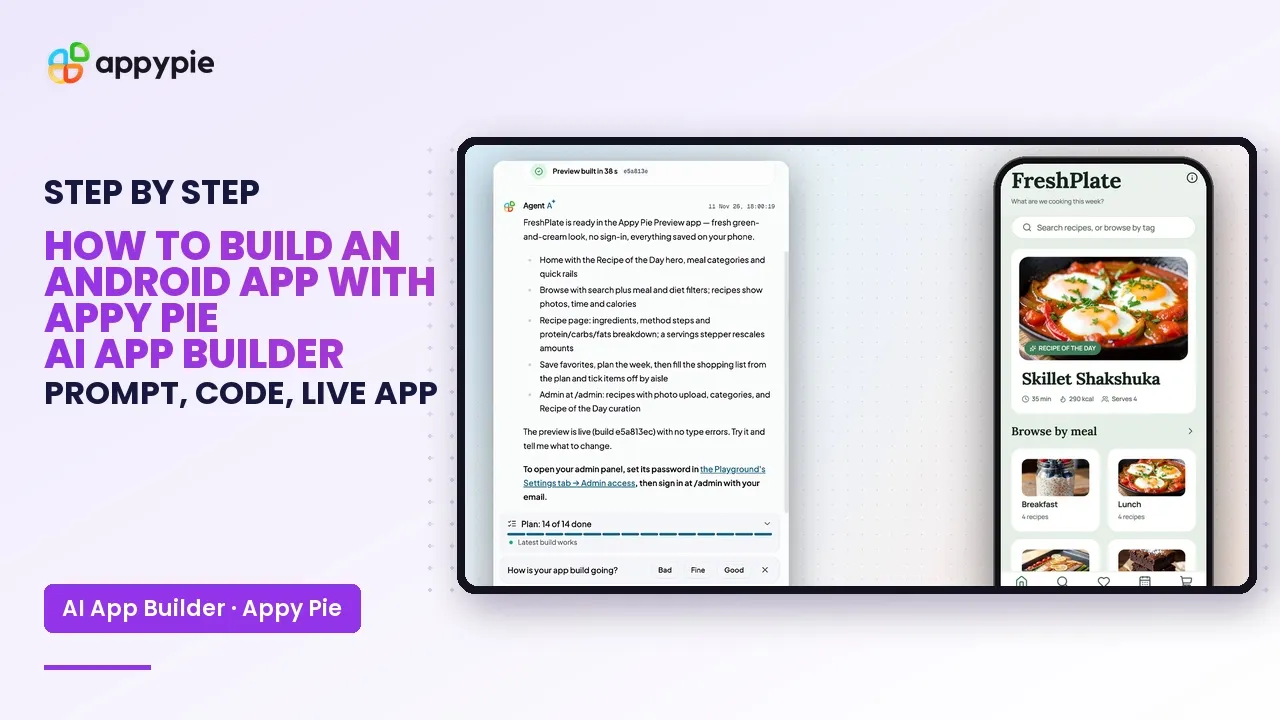
One message to a recipe and meal planner. We describe the app in plain English and answer the agent’s three questions. It makes a 14-step plan, writes the code file by file and puts FreshPlate in the preview about eleven minutes after the prompt. One more message adds an Under 20 min filter, then Publish.
What Our Android App Builder Includes
What the AI builds when you ask for it, on every app it makes.
Sign-In and Accounts
Email and password sign-in with a forgotten-password reset. Add your Google and Apple keys and the Continue with Google and Continue with Apple buttons switch on.
A Backend and Database
Every app gets a backend with an API and a database, so bookings, posts or orders are saved on a server, not only on one phone.
An Admin Page for You
Ask for an admin dashboard and the AI adds a web page at your app’s address where you manage its records. You set its password in Settings.
Push Notifications
Connect your Firebase project and send a notification to every phone that has the app and allows them. Paid plans include a monthly allowance.
Payments
Add Stripe, PayPal or Razorpay keys to take payments for physical goods and real-world services, such as a walk, a class or an order.
In-App Purchases
Subscriptions, premium unlocks and coins go through Google Play billing, as Google requires, and Google pays you.
Photos and Files
Ask for photo or file uploads, such as a dog’s photo or a PDF, and the app stores them on its backend.
Real Code You Can Read
The app is real source code, not a mock-up. Read it in the Code view on any plan; copy it to GitHub on Basic or Platinum.
Your Own Domain
Your app’s backend and admin page get an Appy Pie address. Connect your own domain on a paid plan.
We Built an Android App With the AI Android App Builder
We pressed Get Started for Free on this page, used a Free plan account and sent one message for a dog-walking business. The AI asked four questions, then wrote the app, its backend and an admin page. From our message to a working preview took 9 min 44 s and 27.90 credits, including the time we took to answer.
- Which currency should walk prices be displayed in? (USD)
- Should clients pay for walks directly through the app at checkout? (Pay later / in person)
- Which management tools do you need in your web admin panel? (Walk price & time-slot availability settings)
- How should available walk time slots be set up? (A repeating weekly schedule)
What Paws and Go does, in the AI’s own summary:
- Sign up, sign in (Google and Apple too) and reset a password
- Add each dog's name, breed and walker notes
- Book a 30 or 60 minute walk on a day and time slot, and pay in person
- See upcoming and past walks, and cancel one that is still ahead
- An admin page with the week's bookings day by day, a Mark done button, price and time-slot settings, and a dashboard
- It sends no emails or push alerts and moves no money yet; it told us so when we asked
- There is no cap on dogs per time slot, and the bookings it shows at first are samples
- The admin page needs a password first: you set it in Settings, Admin access, then sign in at /admin
- For Google Play it listed a $25 Google developer account, a signed app bundle built in Appy Pie, and a listing with the same package name, or Appy Pie publishing it for you
“Make an Android app called Paws and Go for my dog-walking business. Customers sign up, add their dog's name, breed and notes, then book a 30 or 60 minute walk for a chosen day and time slot. They can see upcoming and past walks and cancel an upcoming one. I want an admin page where I see all bookings for the week and mark a walk as done. Keep it simple.”
Sign-in · Dogs · Booking · Upcoming and past walks · Admin page


Paws and Go built a second time from the same message through Appy Pie's connector, photographed by the platform's own screen check while signed in as a test user. "App check" in the dog's name is the check's test data.
Android App Builder · No Java, No Kotlin
Skip Android Studio. Skip the SDK setup. Skip the Gradle build errors. Say what you want changed and the AI changes it.
No Java Required
You do not need to know Java, the traditional Android programming language. The AI writes the code for you.
No Kotlin Required
Kotlin is Google’s official Android language. You do not need to learn it. Each change you ask for in the chat is written into the app’s code by the AI.
No Android Studio
Android Studio is a large install with an SDK and an emulator to set up. Appy Pie runs in your browser, and the Android build is made on Appy Pie’s servers.
Change It by Asking
There is no canvas to arrange. Ask for a new screen, a field or a colour, and the AI makes the change. Every change is saved, so you can restore an earlier version.
A Real App, Not a Web Page
The app is real source code that becomes an installable Android app: an .apk to test on your phone, or an .aab for Google Play.
Preview on Your Phone
Scan the QR code with the free Appy Pie Preview app and the app runs on your phone. The preview updates as changes land.
Can You Make a Free App for Android?
Yes. With Appy Pie’s Free plan you can make a free app for Android: describe the app, let the AI build it, change it in the chat and run it on your own phone in the free Appy Pie Preview app. The Free plan gives you 100 credits once; our dog-walking test used 27.90 of them for the first version.
What the Free plan does not include is an Android test build (.apk) or Google Play publishing. Those need the Basic plan at $16 a month ($160 a year), plus Google’s one-time $25 developer registration fee, which every Play Store publisher pays to Google whatever tool they use. The Free plan also includes no app installs from a store or a test build; Appy Pie Preview never counts as one.
If you compare free Android app makers, check what the free tier actually outputs. Most stop at a browser preview; some watermark the app or cap it at a handful of screens. Not sure what to build yet? Our list of profitable app ideas names a real app and its stated revenue for each one.
How to Create an App for Android Online, With Nothing to Install
To create an app for Android online, open Appy Pie in any browser, describe the app, answer the AI’s questions and watch it build. There is no Android Studio to download, no SDK or Gradle setup, and no emulator to configure. The app’s code is written and built on Appy Pie’s servers, and you try it on your phone through the Appy Pie Preview app.
That means it works on a Windows laptop, a Mac, a Chromebook, or Linux, because the build never runs on your device. When the app is ready, Appy Pie builds the signed .aab: download it for your Google Play Console, or let the Appy Pie team submit it for you. Our app publishing guide covers the developer account, the 12-tester rule and review times.
How to Make an Android App: AI App Builder or Android Studio?
Both routes produce a real Android app. For the coded route, timed step by step, see how to make an Android app in Android Studio. The right one depends on three questions, answered honestly:
- Do you need custom native code? Custom Java or Kotlin, an NDK library, Wear OS, Android Auto, or a 3D game engine means Android Studio. Appy Pie does not inject custom code (see the limits section below).
- How soon do you need something in users’ hands? A builder like Appy Pie gives you a working preview in minutes and a store-ready .aab the same day. Learning Kotlin and the Android SDK to the point of a shippable app is typically months; hiring it out runs $5,000 to $50,000 for an MVP.
- Who maintains it afterwards? A coded app needs a developer for every change and every Android version. An app made with Appy Pie is edited by whoever runs the business, with no developer needed.
If you answered “yes” to the first question, Google’s own Android Basics codelab is the place to start. If not, the builder above is the faster route to a published app, and you can still export data and move on later.
Android App Ideas by Industry
There is no template to pick: describe the app for your business and the AI builds it. People start from ideas like these.
Android App Builder vs Native Android Development
What you get with Appy Pie vs hiring an Android developer or learning Java/Kotlin yourself.
| Factor | Appy Pie Android App Builder | Native Android Development |
|---|---|---|
| Cost to build MVP | Free plan, then from $16/mo | $5,000 – $50,000 |
| Time to first working preview | 9 min 44 s in our test | 2 – 6 months |
| Skills needed | None | Java or Kotlin, Android SDK, Gradle |
| Signed Android AAB | Yes | Yes |
| Google Play publish support | Yes, guided | Manual |
| Push notifications built-in | Yes | Firebase setup required |
| Design updates after launch | Ask for the change in the chat, then publish a new build | Change the code, rebuild and resubmit |
| Custom native SDK integration | No | Yes |
| Wear OS / Android Auto / TV | No | Yes |
Appy Pie vs Bubble, FlutterFlow, GoodBarber
Honest side-by-side. We win on speed and simplicity; other tools win on specific advanced use cases.
| Feature | Appy Pie | Bubble | FlutterFlow | GoodBarber |
|---|---|---|---|---|
| Free plan or trial | Free plan (100 credits) | Yes | Yes | No |
| Starting price | $16/mo | $59/mo | $39/mo | From EUR 30/mo, billed yearly |
| AI prompt-to-app | Yes | Beta | Beta | No |
| Signed Android AAB | Yes | Wrapper | Yes | Yes |
| How you build | Chat with the AI | Visual editor | Visual editor | Templates |
| Publish to Play Store | Guided | Manual | Manual | Guided |
| Advanced backend logic | Basic | Advanced | Advanced | Basic |
| Time to first build | 9 min 44 s (our test) | Hours | Hours | Hours |
Publish Your App to the Google Play Store
Appy Pie builds the signed .aab, and you choose who sends it to Google Play: the Appy Pie team, or you.
Google Play Store Publishing
- 1Create your Google Play Console developer account ($25 one-time fee, paid to Google).
- 2In Settings, save your app’s package name, such as com.yourcompany.yourapp, and its icon and name.
- 3Open Publish to Stores and choose Publish with Appy Pie or Publish by myself.
- 4Appy Pie builds the signed .aab, which takes about 30 to 45 minutes on the Basic plan.
- 5The Appy Pie team submits it under your account, or you upload it in Play Console. Google then reviews it.
Two Ways to Publish
- APublish with Appy Pie: you fill in the store listing and book a call; the Appy Pie team builds and submits the app under your own developer account.
- BPublish by myself: download the .aab and upload it to your own Play Console.
- CEither way the build is signed with the Appy Pie keystore, unless you add your own key for an app already on Google Play.
- DEach new build gets a higher version code by itself.
- EA change you ask for in the chat reaches the store app after you publish a new build.
Publishing to Google Play in 2026: What First-Time Publishers Should Expect
Developer account: a personal Google Play developer account costs $25 once. Google verifies your identity, and since 2024 new personal accounts must run a closed test with a minimum number of testers for 14 days before they can apply for production access (check the current tester count in Play Console Help, it has changed once already). Your testers join through Google Play’s own testing track, so plan who they will be before you build.
Target API level: Google requires new apps and updates to target a recent Android API level, and raises the bar every year. The .aab is built on Appy Pie’s servers for you, so there is no build setting for you to change.
Data safety form and privacy policy: every listing needs a completed data safety section and a privacy policy URL. List what your app collects, such as accounts, bookings or photos, so the form matches the app.
Review time: most first submissions are reviewed within a few days; policy problems (adult content, gambling where restricted, misleading claims) are the usual reasons for rejection, and they are listed in the limits section below.
APK vs AAB: Which File Do You Get?
Both, on the Basic plan. The .aab (Android App Bundle) is what Google Play requires for new apps; Play makes optimised APKs per device from it. The .apk is a test build you install on your own Android phone; it is never uploaded to a store. Appy Pie signs both with its own keystore unless you add yours. To turn an existing website into an APK rather than design an app from scratch, use the website to APK converter.
Real Android Apps Built on Appy Pie
Three customers, three countries, all live on Google Play today. Full stories on our customer stories page.
Memorial Tacos
A taqueria launched its own ordering app to stop paying third-party delivery commissions and to own its customer list.
DO Max
An entertainment brand consolidated movies, live TV, and games into one Android and iOS app instead of three separate destinations.
Woodloch Resort
A family resort put dining menus, activity schedules, and resort updates in one guest app ahead of its peak season.
What Our Android App Builder Doesn’t Do
Straight talk on what to expect. If any of these are a hard requirement, native Android development or another tool is a better fit.
No Native Java/Kotlin Code
You cannot inject custom Java or Kotlin code. If you need low-level SDK access or custom NDK (native C++) integrations, use Android Studio.
No Wear OS or Android TV
Appy Pie builds for standard Android phones and tablets. Wear OS smartwatch apps, Android Auto, and Android TV builds are not supported.
Not for High-End Games
Appy Pie is not a game engine. If you’re building a Unity, Unreal, or Godot 3D game, use those platforms. For a light arcade, puzzle, quiz or word game app, use the AI game app builder. Making a mobile game app shows one built, played and priced for both stores.
Not for Rooted-Device Features
Apps that require rooted Android access, custom kernels, or system-level permissions won’t build on our platform. Play Store policy also blocks most of these.
Code Export Needs a Paid Plan
You can read the code in the Code tab while you build. Exporting it to GitHub comes with Basic and Platinum, not the Free plan.
No Google Play Store Guarantee
We help you meet Play Store requirements, but Google’s review process is out of our control. Policy-violating content (adult, gambling in some regions) will be rejected.
Trusted by 10M+ App Creators on Appy Pie
Real feedback from small business owners, agencies, and solo founders.
“I built and launched an Android app for our salon in a weekend. Booking is now 60% via the app. Would have cost me $15K to hire a dev.”
“The AI-generated first draft of my e-commerce Android app was 80% of what I needed. I just tweaked colors and added my products.”
“I run a small agency and Appy Pie lets me deliver Android apps to clients in weeks instead of months. Margins are way better.”
Start Building Your Android App Free Today
Describe your app idea, answer a few questions, and try a working Android app on your phone. Publish to Google Play when you’re ready.
Android App Builder – Frequently Asked Questions
Everything people ask before building their first Android app on Appy Pie.
Can I build an Android app with AI?
Yes. You describe your app in plain English, Appy Pie’s AI asks a few questions and builds a working first version, and you change it by asking in the same chat. When it is ready, Appy Pie builds a signed .aab for Google Play. No Java, Kotlin, or Android Studio required. For a step-by-step walkthrough, read our guide on how to create an app.
How long does it take to build an Android app with Appy Pie?
In our test, a dog-walking booking app went from one message to a working preview in 9 min 44 s, including four questions the AI asked first. A Google Play build then takes about 30 to 45 minutes, and Google’s review comes after that.
Is Appy Pie’s Android app builder free?
You can build, change and preview your Android app free on the Free plan, which gives you 100 credits once. Basic at $16 a month ($160 a year) is needed for an Android test build (.apk) and for publishing to the Google Play Store.
Do I get a native Android app or a web wrapper?
The AI writes the app as real source code, and Appy Pie builds it into an installable Android app: an .apk you install on your own phone to test, or an .aab for Google Play. Every app also gets a backend with a database on Appy Pie’s servers.
Can I publish to the Google Play Store?
Yes, on the Basic plan. Appy Pie builds the signed .aab (about 30 to 45 minutes). With Publish with Appy Pie the Appy Pie team submits it under your own Google Play account; with Publish by myself you download it and upload it in Play Console. Google charges $25 once for the developer account.
What Android app types can I build?
Any app you can describe: bookings, a store, a club or community, a menu and orders, a course, a light game. There is no template to pick. The AI builds phone apps, so even a request for a website is built as an app.
Does the AI Android app builder support push notifications?
Yes. Every app the AI builds has a backend, so it can receive push notifications once you connect your Firebase project. You send a notification to every phone that has the app and allows them; paid plans include a monthly allowance, and you can buy more.
Can I add my own code or SDK integrations?
You can read the app’s code in the Code view, and on Basic or Platinum copy it to GitHub. To change the app inside Appy Pie, ask the AI in the chat. Payments use Stripe, PayPal or Razorpay keys, and sign-in can add Google and Apple.
Can I convert an existing website to an Android app?
Yes, but that is a separate flow. Use Convert Website to App to turn an existing site into an Android app, or use this Android App Builder to have the AI build a new app from scratch.
What about iOS?
The same project builds for iPhone too. Publishing to the App Store needs the Platinum plan ($60 a month) and Apple’s $99 a year developer program. See our iPhone App Builder.
Can I make an Android app for free and publish it?
You can make and test an Android app for free in the Appy Pie Preview app. Publishing it to Google Play needs the Basic plan ($16 a month) and a Google Play developer account in your own name ($25 one-time, paid to Google). Basic also makes an .apk test build you can install on your own phone without a store listing.
Do I need a Mac, a specific computer, or Android Studio?
No. Appy Pie runs in the browser and builds the Android app on its own servers, so any laptop, Chromebook, or desktop works. Android Studio is not required.
